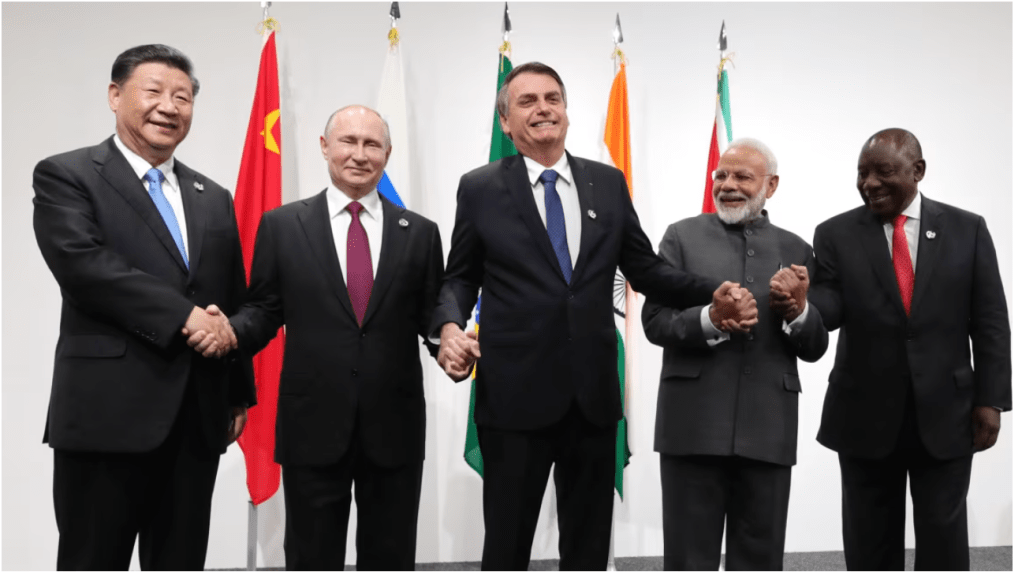
For the past century, the United States has been the undisputed global superpower. The dollar was established as the global currency in 1944 through the Bretton Woods Agreement, which was signed by the IMF and the World Bank, giving the U.S. a 16.5 percent voting share and veto power over international financial decisions. In 1971, under President Nixon, the U.S. abandoned the gold standard, making the dollar a fiat currency backed only by the American economy.
This shock was managed when Saudi Arabia agreed to sell its oil exclusively in dollars. In 1973, the agreement solidified as the Saudis secured military protection in exchange for dollar-denominated oil sales, thereby cementing the dollar’s dominance in global commodity markets. This unchallenged rule lasted until 1999 when the Euro launched. Within a decade, the Euro reached 28 percent of global reserves, compared to the dollar’s 62 percent, representing the first major challenge to the dollar’s hegemony. In 2001, Goldman Sachs economist Jim O’Neill identified Russia, Brazil, China, and India as rising economic powerhouses that would rival the G7 by 2050, coining the term “BRICS.”
The first BRIC Foreign Ministers Meeting occurred in 2006, beginning informal economic cooperation discussions without a formal institutional structure. The 2009 Yekaterinburg Summit saw leaders unanimously call for a “diversified, stable and predictable” currency system, criticizing the dollar’s inadequacies during the 2008 financial crisis. China proposed moving toward an SDR-based system. In 2010, South Africa joined, making BRICS represent 42 percent of the global population and 23 percent of global GDP. The 2014 BRICS New Development Bank was established in Shanghai with $100 billion in capital, directly challenging the IMF and World Bank’s monopolization of the international financial architecture. The Contingent Reserve Arrangement offered an alternative to traditional IMF bailout mechanisms.
Following Russia’s 2014 Crimea annexation, comprehensive U.S. and EU sanctions served as a catalyst, prompting Russia to develop SPFS as a SWIFT alternative to maintain financial sovereignty. Russia-China local currency settlement accelerated, increasing 800 percent between 2014 and 2020, demonstrating the viability and proliferation of dollar-independent trade. In 2015, China launched the Cross-Border Interbank Payment System, enabling yuan transactions outside the SWIFT infrastructure. By 2020, CIPS had processed $12.7 trillion in transactions.
That year, the yuan joined the IMF’s SDR basket at 10.92 percent versus the dollar’s 41.73 percent, marking its arrival as a major reserve currency. China launched the Shanghai Gold Exchange in 2016, pricing contracts in yuan and challenging London-New York dominance in precious metals trading. In 2017, the petro-yuan futures market enabled oil trading in yuan convertible to gold, bypassing the dollar entirely. Russia’s dollar reserves fell dramatically from 46 percent in 2018 to 23 percent by 2019 as it diversified into euros, yuan, and gold, demonstrating how the dollar’s dominance was being eroded.
The National Wealth Fund eliminated dollar assets, signaling complete financial decoupling. COVID-19 in 2020 triggered unlimited Federal Reserve quantitative easing, flooding global markets with dollars. Emerging markets including Turkey, Argentina, and Pakistan suffered severe currency crises, renewing urgent calls for alternatives to the dollar-centric system. Russia’s February 2022 Ukraine invasion marked a watershed moment and critical catalyst for escalation.
Western nations expelled Russian banks from SWIFT, deploying the “nuclear option” of financial sanctions. Russia’s SPFS activated immediately, shifting 20 percent of domestic transactions from SWIFT within weeks. In March 2022, Western nations froze $300 billion in Russian reserves, an unprecedented asset freeze in history. China, India, and Saudi Arabia carefully noted their vulnerability to similar actions. Putin demanded “unfriendly” nations pay for gas in rubles, partially de-dollarizing energy trade. India began purchasing heavily discounted Russian oil in rupees. Bilateral trade spiked from $13 billion in 2021 to $50 billion by 2023, demonstrating the economic viability of non-dollar transactions.
The August 2022 Beijing Summit discussed creating BRICS currency and payment systems. Putin explicitly stated: “The matter of creating an international reserve currency based on our countries’ currencies is under review.” In 2023, Saudi Arabia considered pricing oil contracts in yuan, signaling the potential end of the fifty-year petrodollar monopoly that had underpinned American financial dominance. The August 2023 Johannesburg Summit expanded BRICS to include Argentina, Egypt, Ethiopia, Iran, Saudi Arabia, and the UAE.
This expansion meant BRICS collectively controlled 72 percent of rare earth minerals and 42 percent of oil reserves. The mBridge digital currency platform completed successful 2024-2025 pilot testing with China, Thailand, the UAE, and Saudi Arabia, processing $22 billion and demonstrating viable alternatives to dollar-based settlement systems. Russia-China achieved 95 percent local currency settlement in bilateral trade, with the dollar’s share plummeting from 80 percent in 2021 to just 5 percent. The UAE’s acceptance of Indian rupees for oil purchases marked a historic break from the petrodollar monopoly, while India expanded rupee settlements to $30 billion across 18 countries. At the October 2024 Kazan Summit, BRICS formally proposed the Cross-Border Payment Initiative as a comprehensive SWIFT alternative, with the declaration emphasizing “strengthening correspondent banking networks and enabling settlements in local currencies,” signaling a paradigm shift toward a multipolar financial order and the decisive transition from aspirational rhetoric to operational implementation.
 Salmanwrites.com
Leave a comment